Research Interests
Machine Learning
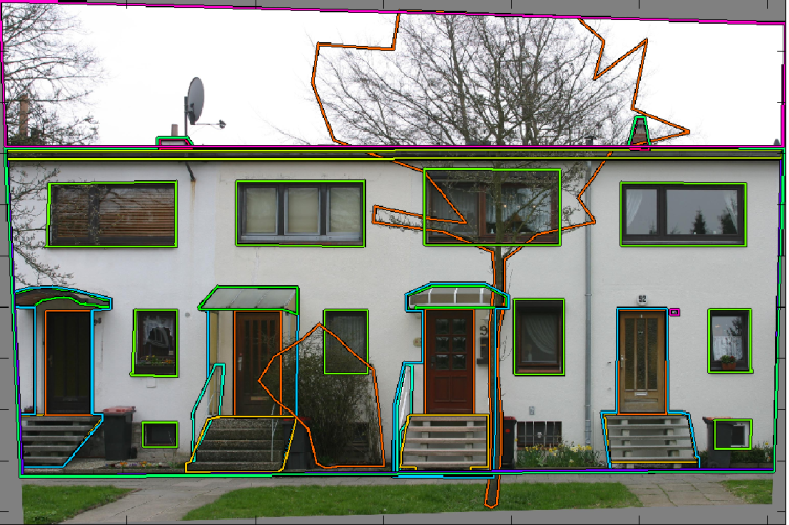
- High-level structure model learning
- Probabilistic pattern matching
- Probabilistic graph matching
- Ontology learning and reasoning
Scene Interpretation
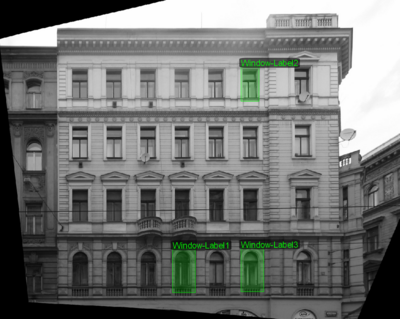
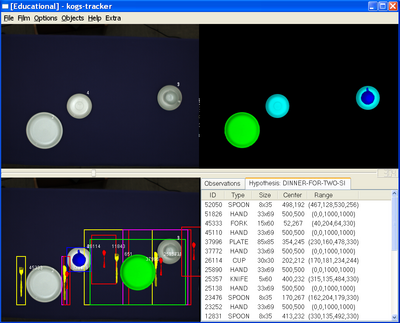
- Formalise the interconnection between image model learning and image understanding
- Automatic evaluation of learnt models
Other
- Cognitive Science
- Philosophy
Projects
eTraining for Interpreting Images of Man-Made Scenes (eTRIMS)
eTRIMS is a research project funded by the European Community under the grant IST 027113 in the EUCognition I framework. The aim of the project is to advance the state of the art of cognitive systems by developing a methodology for autonomous and continuous learning. The project will concentrate on structural learning, where relations between components and compositional hierarchies play a central role in object categorization. Such learning is particularly relevant for the interpretation of man-made objects, hence the project will use the recognition of buildings in outdoor scenes as its exemplary application domain.
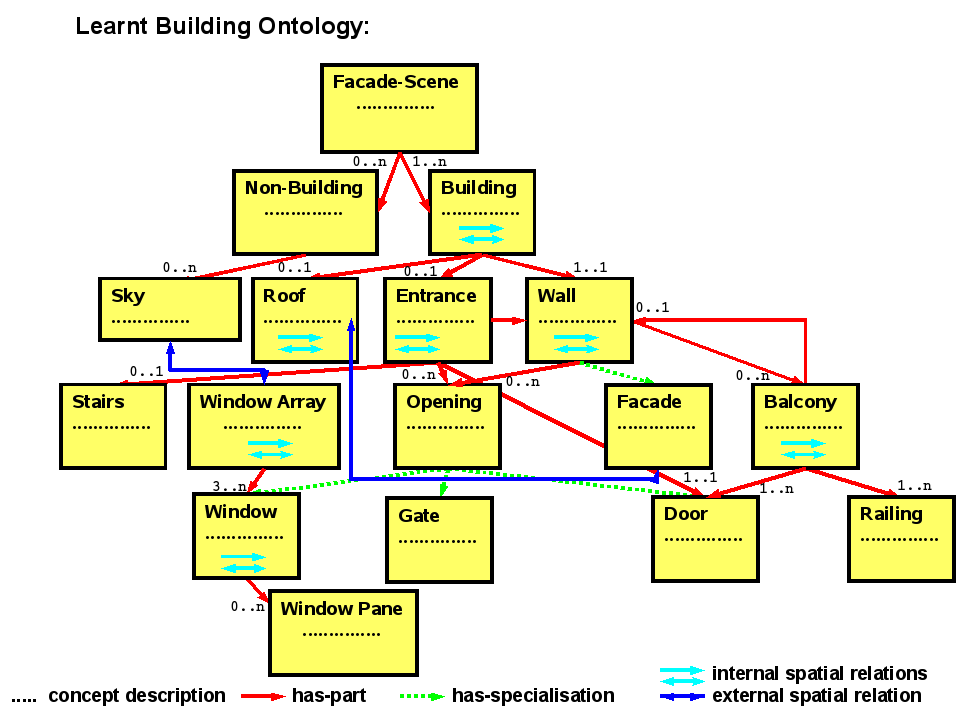
The ontology presented above is learnt automatically using a Version Space framework [Hartz,Neumann; ICMLA07]. All concepts are described through a rich description language employing logic-based and probabilistic attribute types. Spatial relations are represented both in symbolic and probabilistic ways.
Involvement in the project:
Apr 2006 - Sep 2009
Work done in the project:
- Developed Version Space Learning of spatial structures
- Author of project deliverable D 2.4: Concepts for Case-based Learning
- Co-Author of project deliverable D 1.3: Empirical Evaluation of methods
- Co-Author of project deliverable D 3.1: Scene Interpretation with learnable models
- Held 2 talks at official project review meetings
- Held 6 talks at internal project meetings
Cognitive & Flexible learning system operating Robust Interpretation of Extended real scenes by multi-sensor Datafusion (Co-FRIEND)
The Co-FRIEND project aims to design a framework for understanding human activities in real environments, through an artificial cognitive vision system, identifying objects and events, and extracting sense from scene observation. It will manage uncertainty and change, and will create analysis meaning:
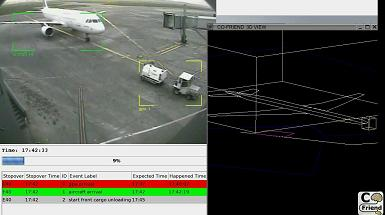
A heterogeneous sensor network, composed of wide angle and PTZ cameras and GPS
vehicle monitoring, will be deployed on Toulouse airport. Multi-data fusion and
feedbacks will be exploited to achieve robust detection and efficient tracking
of objects in real and complex video scenes. The scene understanding will be
assisted by machine learning, providing advance reasoning capabilities compliant
in a largely unsupervised way to variations and novelties.
Involvement in the project:
Oct 2009 - Feb 2011
Work done in the project:
- Developed generic graph-based structure learning method
- Held 2 talks at internal project meetings
Publications
2010
Johannes Hartz, Arne Koopmann, Patrick Kreutzmann, Kasim Terzic: eTRIMS Scene Interpretation Datasets, Technical Report FBI-HH-M-345/10, , Department of Informatics, University of Hamburg, Nov 2010 [PDF]
2009
Johannes Hartz: Learning Probabilistic Structure Graphs for Classification and Detection of Object Structures, IEEE Proceedings of the International Conference on Machine Learning and Applications 2009, Miami (Florida, USA), Dec 2009 [PDF]
Johannes Hartz; Lothar Hotz; Bernd Neumann; K.Terzic: Automatic Incremental Model Learning for Scene Interpretation, Proceedings of the International Conference on Computational Intelligence (IASTED CI-2009), Honolulu (Hawaii, USA), Aug 2009 [PDF]
2007
Johannes Hartz; Bernd Neumann: Learning a Knowledge Base of Ontological Concepts for High-Level Scene Interpretation, IEEE Proceedings of the International Conference on Machine Learning and Applications 2007, Cincinnati (Ohio, USA), Dec 2007 [PDF]
Johannes Hartz; Bernd Neumann: Version Space Learning of Ontological Structures for High-level Scene Interpretation, Technical Report TR FBI-B-277/07, Department of Informatics, University of Hamburg, Sep 2007 [PDF]
Talks
2008
Offenbach (Germany), 03.03.2008, Invited talk at Honda Research Institute Europe, "Learning for High-Level Vision"
Hamburg (Germany), 18.06.2008, Second year eTRIMS project review meeting, "Evaluation of learnt conceptual models in SCENIC"
2007
Bonn (Germany), 19.07.2007, First year eTRIMS project review meeting, "Continuous Learning of Ontological Concept Descriptions"
Cincinnati (Ohio, USA), 15.12.2007, International Conference on Machine Learning and Applications 2007, "Learning a Knowledge Base of Ontological Concepts for High-Level Scene Interpretation"
Misc
since 2009
Member of the EUCognition II network for the advancement of the understanding of artificial cognitive systems
2008
Chamonix (France), 06.01.2008 - 12.01.2008, Winter School, "Bayesian Cognition"
2007 - 2008
Member of the EUCognition I network for the advancement of the understanding of artificial cognitive systems