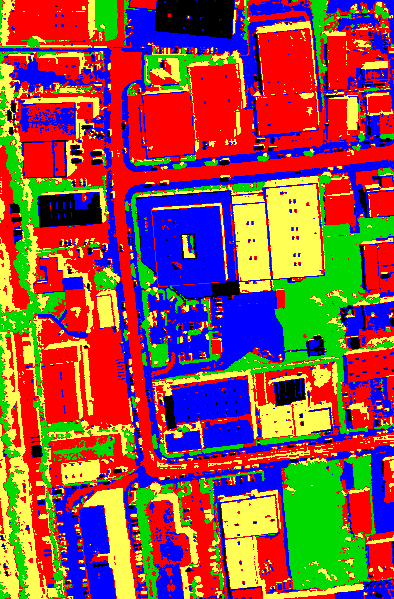
When two images are classified, the agreement of classification can be expressed by a confusion matrix [Richards (1993)]. As an example, the following confusion matrix was found after both the true and fused image of the urban area (Figure 1, example classification) were classified into three ground cover classes:
| Original Image Class | |||||
| A | B | C |  | ||
| Fused | A | 117481 | 0 | 2136 | 119617 |
| Image | B | 0 | 11274 | 2 | 11276 |
| Class | C | 2069 | 171 | 106867 | 109107 |
| | 119550 | 11445 | 109005 | 240000 | |
To quantify the agreement of classification, the
kappa coefficient [Congalton (1991)] can be used, which is defined by

where  is the overall accuracy given by the sum over the diagonal
matrix elements:
is the overall accuracy given by the sum over the diagonal
matrix elements:

From this number the fraction  of pixels that could have been
accidentally classified correctly has to be subtracted:
of pixels that could have been
accidentally classified correctly has to be subtracted:

This has to be done, because even if the pixels were assigned to the
classes completely at random, some pixels would nevertheless be
assigned to the same class for both images.
The kappa coefficient for the above confusion matrix is  , which would be assessed as an excellent agreement
[Ortiz et al. (1997)].
, which would be assessed as an excellent agreement
[Ortiz et al. (1997)].
Both the original and fused images of the two scenes (urban, vegetation) were classified, while varying the number of classes. The result is shown in Figure 11.
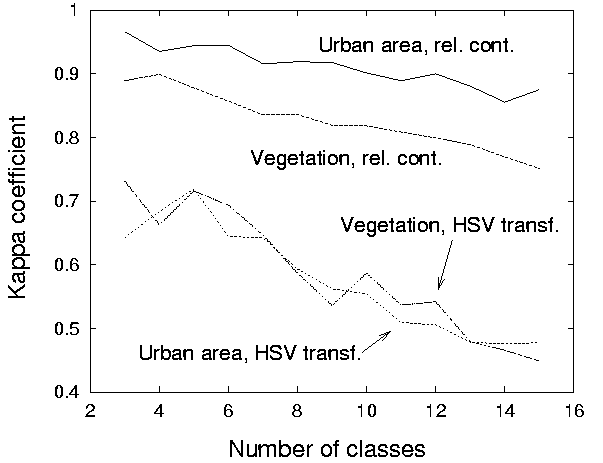
Figure 11: Classification Agreement.
Generally, the kappa coefficient decreases with increasing number of classes, which can be explained by the increasing number of transition areas between classes in the image. At these land cover class borders, the multispectral information is blurred and misclassification occurs. Furthermore, the fusion using relative contributions gives a better agreement of classification, which is due to the better correlation between the images, as shown in Section 4.1. Another effect that is observed is that the urban area image is classified more consistently, which is due to the greater variation in the spectral information. In the vegetation example, the classes are very similar, so that misclassification becomes more probable.