


Because the results of the fusion by HSV transformation were not fully
satisfactory, also a second fusion method was examined, which can be
described by the equation

where  is the newly created fused image,
 is the multispectral (color infrared)
image with 4 m resolution,
is the multispectral (color infrared)
image with 4 m resolution,  is the highly
resolved panchromatic image, and
is the highly
resolved panchromatic image, and  is a
panchromatic image created by averaging the three bands of the
multispectral image. In principle the first term in the above equation
describes the spectral information while the spatial information is
represented by the panchromatic image .
is a
panchromatic image created by averaging the three bands of the
multispectral image. In principle the first term in the above equation
describes the spectral information while the spatial information is
represented by the panchromatic image .
In contrast to the HSV transformation this fusion method produced images which were better correlated to those truly sampled at 1 m (see Section 4.1). Another advantage of this technique is that it is possible to fuse images with any number of bands, that cannot be coded by red, green and blue.
The result of an application of this technique to the examplary image shown here can be seen in Figure 5. In addition to the above recipe (Section 3.1), after the magnification of the color image (step 2), the color image was smoothed in a sliding local window of the size of the resolution ratio (here 4x4 pixels). This amounts to a bilinear interpolation between the known color values at the coarse resolution grid, and achieves the surprisingly `sharp-looking' CIR image (Figure 4).
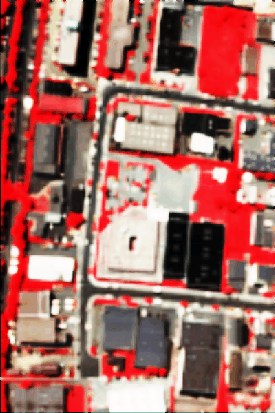
Figure 4: Color infrared image of urban area, after bilinear
interpolation of 4 m-image.
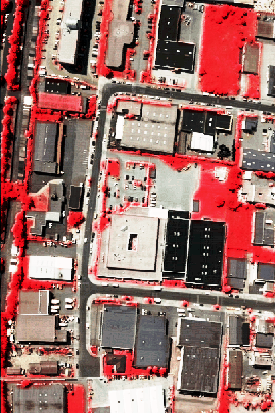
Figure 5: Color infrared image of urban area, fused from panchromatic
image at (1 m) and color infrared image (4 m).