


The normalized difference vegetation index (NDVI) which is used
e.g. for vegetation health monitoring is defined by

where  is the near infrared band and
  is the
red band. In Figure 8 the NDVI values of the original and
the fused color infrared image are regressed for the exemplary image showing
an urban area (Figure 1). The correlation coefficient
for this image is
is the
red band. In Figure 8 the NDVI values of the original and
the fused color infrared image are regressed for the exemplary image showing
an urban area (Figure 1). The correlation coefficient
for this image is  while the root mean square deviation is
 .
.
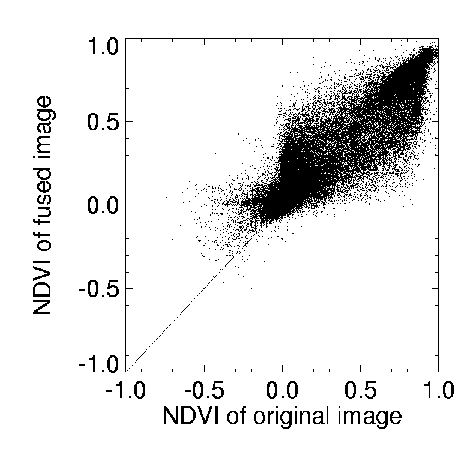
Figure 8: Normalized Difference Vegetation Index of urban area.
Similarly, in Figure 9 the same variables are plotted for
the vegetation area shown in Figure 10. Here, the
correlation coefficient is higher ( ) and the deviation
lower (
) and the deviation
lower ( ) than that of the urban area image. The reason
for this is the lower spectral variability of the vegetation
image. While in the urban area there are many transition lines from
vegetation to non-vegetation, the vegetation image is quite
uniform. Therefore, the blurring of the spectral information induced
by fusion has a smaller effect on the latter image.
) than that of the urban area image. The reason
for this is the lower spectral variability of the vegetation
image. While in the urban area there are many transition lines from
vegetation to non-vegetation, the vegetation image is quite
uniform. Therefore, the blurring of the spectral information induced
by fusion has a smaller effect on the latter image.
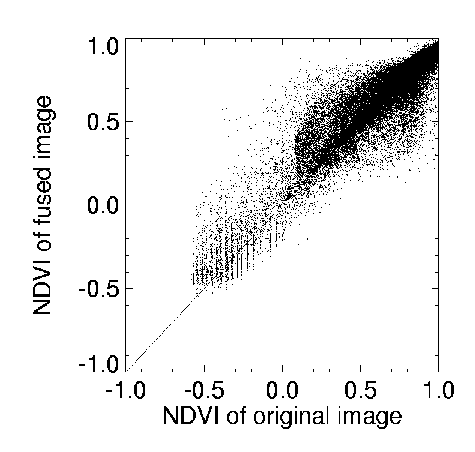
Figure 9: Normalized Difference Vegetation Index of vegetation area.
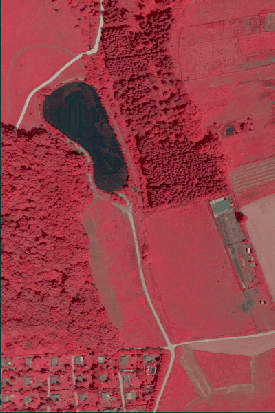
Figure 10: Vegetation area near Nürnberg.